Voices of the World: A Tour of World Music Traditions
In the summer of 2023, a random opportunity came my way through time spent at Feytopia in France. I was tapped to create several experiences for the Sonic Sphere, a 60-foot geodesic concert hall with 124 speakers arranged in a three-dimensional array inside The Shed in Hudson Yards, NYC. The projects included music that served as a spatial score for spoken word poets, as well as an ethnomusicology study of world vocal traditions. This post is about the latter.

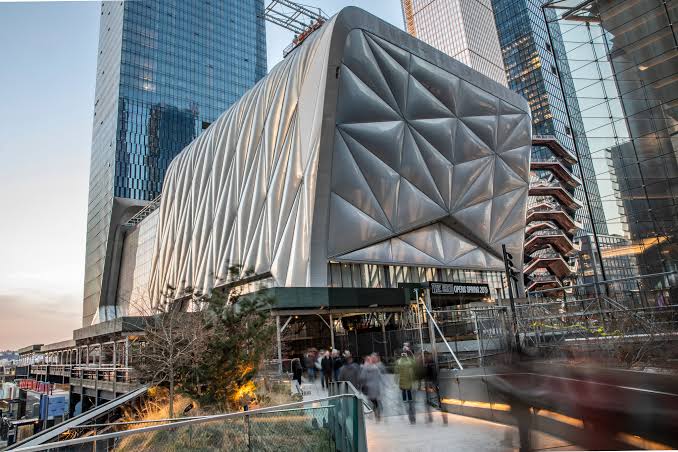
The venue was The Shed in Hudson Yards, a massive building on wheels that slides out from the side of a skyscraper to create a cavernous open space. The Sonic Sphere itself was hung from the ceiling inside, a 60-foot geodesic structure with 124 speakers embedded in its surface.
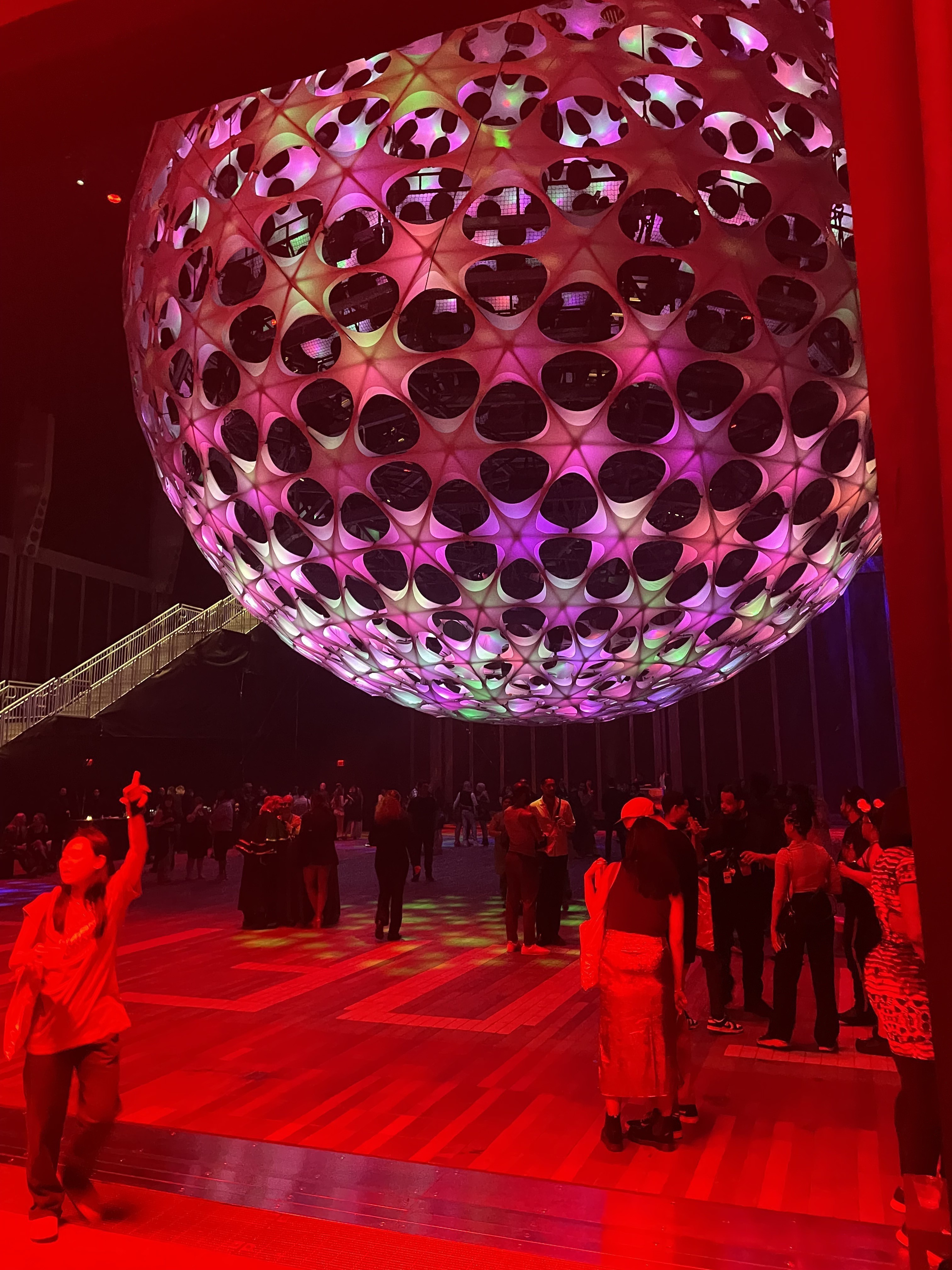
The piece is called "Voices of the World: A Tour of World Music Traditions." It's a 45-minute journey through vocal music from every continent, mixing my own field recordings with recordings I've gathered from other sources over the years. The audience reclines on nets suspended inside the sphere while the sound moves around and through them in full 360-degree spatial audio.
The idea
The human voice is the original instrument. Every region on earth has developed a unique way of using it to make music, and those vocal traditions carry something essential about the people who created them. Even when you don't understand the language, you can connect with the essence of who they are through the sound alone.
I wanted to take that idea and put it inside the most immersive listening environment that exists. The Sonic Sphere let me place each recording in three-dimensional space, so that a choir from Bulgaria could surround you from above while throat singers from Tuva rumbled beneath your feet. The technology served the music in a way I'd never experienced before.
The journey
The piece moves through the world in a loose geographic arc:
The Rainforest. We start deep in the Brazilian Amazon with the Ashaninka, an indigenous group whose ceremonial singing mirrors the canopy itself. Multiple singers perform different melodies simultaneously, each one beautiful on its own, forming a mosaic when heard together. From there we hear a Shipibo medicine woman from Peru and a piece called "Kworo Kango" by the Tupi people of Brazil.
Latin America. Afro-Brazilian maracatu, Chilean choral music from Coral Rojo, and the lush harmonies of traditional Mexican vocal music.
European polyphony. The polyphonic traditions of Corsica and Sardinia, then east to the Bulgarian folk choirs, then further east to Georgian folk singing.
The British Isles. Traditional Scottish singing, a protest song from northern England, and Irish lilting.
Appalachia and America. Irish music is the grandfather of Appalachian folk music, so we follow that thread across the Atlantic. Then vocal jazz, including one of my favorite recordings of the Four Freshmen singing "It's a Blue World."
The adventurous section. Tuvan throat singing, Balinese kecak, Native American powwow music, hocketing, South Indian konnakol, and traditional German yodeling. This section was about showing the full range of what humans can do with their voices.
Africa. Tuareg music from the Sahara, traditional Nubian music performed by oud player Hamza El Din, Rokia Traore from Mali, the harmonies of a South African group called The Joy, the ritual bung-o horn of Kenya, and closing with the yelli music of the Baka pygmies from Gabon and Cameroon.
What it felt like
Recordings I'd listened to hundreds of times on headphones became completely different when they surrounded you physically. The Ashaninka ceremony, with all those overlapping melodies, was especially interesting in the sphere. You could hear each voice coming from a different point in space, the way you would if you were standing in the middle of a ceremony in the forest.
Grateful to The Shed and the Sonic Sphere team for the opportunity.